Crypto-currencies
The table below shows the crypto-currencies currently supported in Nexus and their internal codes.
| Crypto-currency | Nexus internal code | Business model |
|---|---|---|
| Algorand | ALGO |
Broker, Custodian |
| Bitcoin | BTC |
Broker, Custodian |
| Bitcoin Cash | BCH |
Broker, Custodian |
| Cardano | ADA |
Custodian |
| Chainlink | LINK |
Custodian |
| EOS | EOS |
Custodian |
| Ethereum | ETH |
Broker, Custodian |
| Litecoin | LTC |
Broker, Custodian |
| Polkadot | DOT |
Custodian |
| Ripple | XRP |
Custodian |
| Stellar Lumens | XLM |
Broker, Custodian |
| USD Tether | USDT |
Custodian |
Crypto-currency settings
Nexus allows you to configure advanced settings for each supported crypto-currency. These preferences help you tune spread behavior and payment delay windows.
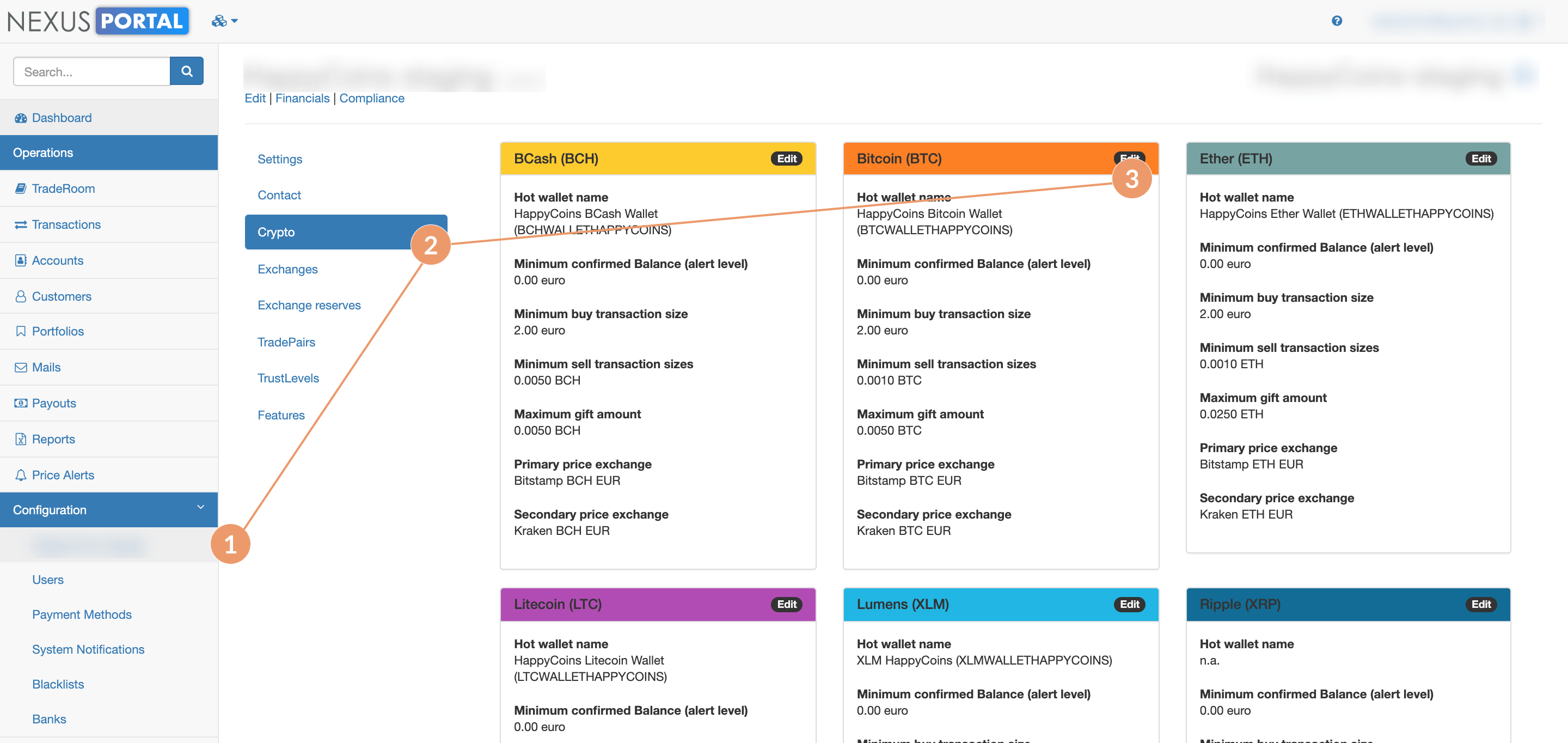
Open the Crypto-currencies overview page by clicking Configuration -> YourCompanyName and selecting Crypto in the left sidebar. Then select the crypto-currency you want to configure (BTC in the example below) and click Edit.
On the Edit page, the main section for pricing behavior is {Cryptocurrency} internal pricing settings (see image below).
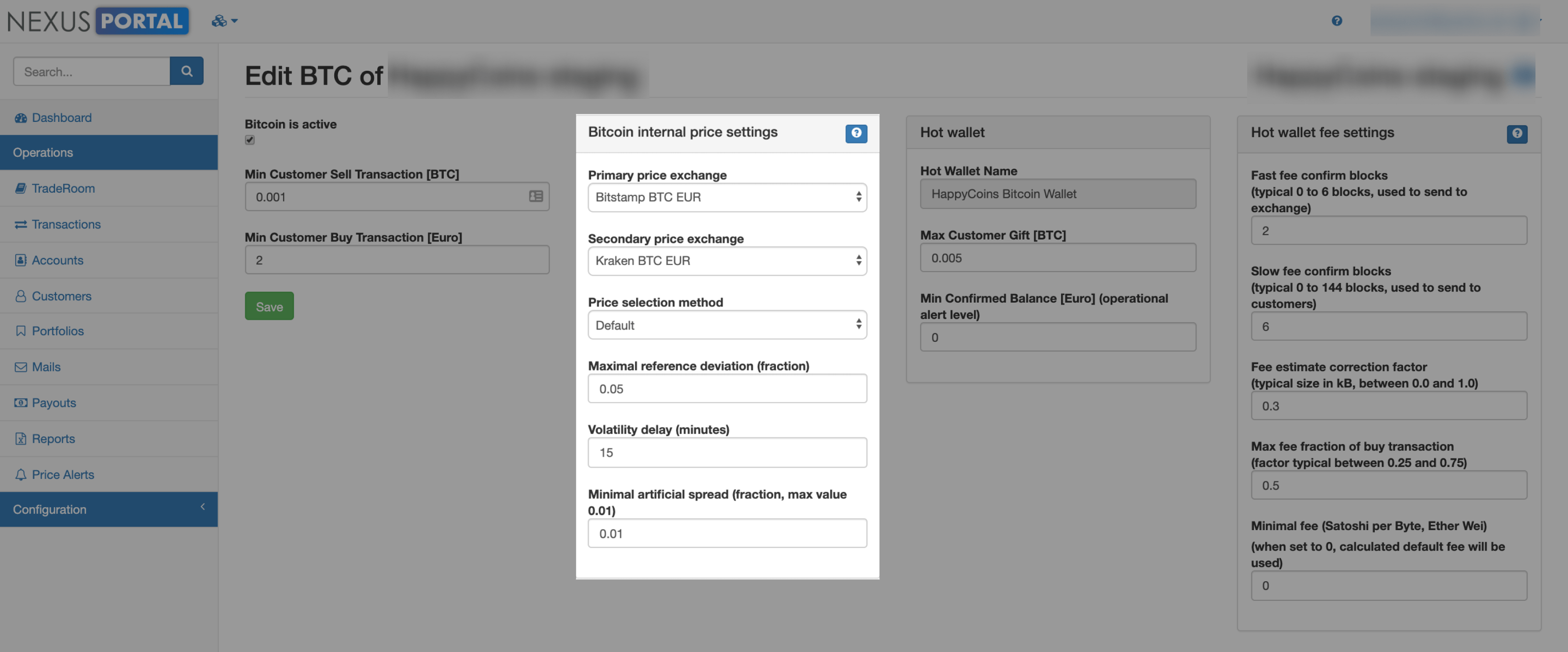
What do these parameters mean, and what do they influence?
- Primary / secondary price exchange: choose which available exchanges act as the primary and secondary source for up-to-date prices. These settings influence the next parameter.
- Price selection method: defines the strategy used to retrieve prices from the selected exchanges.
- Default: the bid/ask price is retrieved from the primary exchange, with the secondary exchange used as fallback.
- MinPrice: the price will be established by choosing the exchange which has the lowest average value between bid and ask price.
- MaxPrice: same as MinPrice, with the difference that the exchange with the highest average value between bid and ask price is selected.
- MinSpread: the lowest ask price and highest bid price are chosen between the primary and secondary exchanges.
- MaxSpread: the highest ask price and lowest bid price are chosen between the primary and secondary exchanges.
- Maximal reference deviation: sets the accepted price difference between price sources/exchanges. This helps prevent losses caused by inaccurate prices when exchanges have issues (for example, outages or compromised data). Nexus always uses at least 3 reference sources. An exchange ticker is only used when it is at most 1 minute old and deviates less than the configured maximal reference deviation (for example,
0.03means up to3%). - Volatility delay: sets the delay window (in minutes) in which a customer can still buy at the fixed quoted price. This reduces the risk that customers wait for favorable volatility while keeping an outdated quote.
- Minimal artificial spread: lets you define a symmetric minimum spread on bid/ask prices from your price sources (maximum
1%). This can add profit margin and extra risk control during volatile periods. If buy and sell transactions can be matched internally, you can settle directly between wallets and still benefit from this configured spread.
Crypto functionality
- Sending halted: blocks sending of already created on-chain customer transactions for broker and custodian models.
Minimize risk
Dealing with crypto-currencies and fiat reserves can generate gains, but also introduces risk. The guidance below helps you balance operational needs and risk exposure.
Keeping reserves in the right place is essential.
Storing crypto-currency amounts on the Nexus exchange reserve means access depends on the external exchange service (for example, Kraken or Bitstamp). If the exchange is temporarily unavailable due to technical issues or other reasons, those funds cannot be redeemed until service resumes. For this reason, keep only the amount needed for daily operations on the exchange reserve.
Another storage option is the hot wallet reserve. Similar risks apply: hot wallets can be compromised. Keep only the amount needed for regular transfer activity.
For larger long-term holdings, the safest option is the cold store reserve, which lets you connect your own cold store wallet/service.
The transfer of funds between these different storage options can be either executed manually or through our Nexus Tradebot. For a more in-depth explanation, refer to Tradebot — Broker model and Tradebot — Custodian model. By using Tradebot, you can balance price risk versus potential transaction spread benefit.
WARNING
Depending on your business model, you may choose to hold a limited crypto position. Because crypto-currency prices are volatile and can change significantly day to day, these additional funds represent financial risk and may lead to gains or losses.